Is it Cheaper to Get a New or Used Car Right Now?
When visiting most lots today and the problem is not choice — it is limited choice. Franchise stores now order closer to demand, stocking narrow slices of trim and color instead of deep rows of everything. That just-in-time discipline protects the dealer’s floorplan cost, but it means the exact configuration a buyer wants may sit three states away while a nearly identical car waits unsold nearby.
At the same time, the gap between late-model pre-owned pricing and entry-level new pricing has narrowed into a compressed band where the two categories genuinely compete. That makes total cost of ownership — payment, insurance, fuel or electricity, scheduled service, tires, and projected resale — an effective way to compare listings of new and used cars for sale.
Is it Cheaper to Get a New or Used Car Right Now?
A new vehicle absorbs its steepest depreciation early; a used one hands you that discount and the repair schedule that comes with age. The deciding variable is usually credit cost. Manufacturer-subsidized rates on slow-moving new models can undercut typical used-car financing enough to erase the used car’s price advantage over a full loan term.
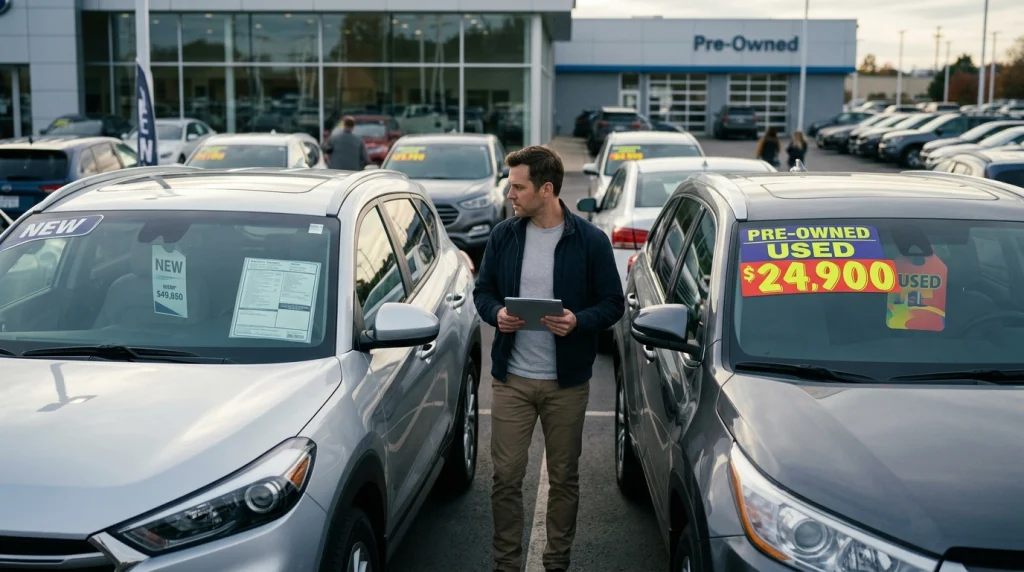
Certain classes resist the math entirely. Compact crossovers, such as used Honda CR-Vs and RAV4s, stay stubbornly expensive because demand never softens, so shoppers comparing used car prices in that segment should price the new equivalent before assuming used wins.
What is the $3000 Rule for Cars?
The $3000 rule suggests keeping a reserve of roughly three thousand dollars available after the purchase, because a used car’s first year is where deferred maintenance surfaces. Buyers who spend their last dollar on the down payment convert a minor repair into a financial emergency.
Modern vehicles raise the stakes. Windshield replacement now often requires camera recalibration, and infotainment or module updates may be dealer-only work. Split the reserve mentally: immediate needs such as tires, brakes, fluids, and alignment, then long-term reliability items like timing components, suspension bushings, and battery or hybrid system service.
Strategic Sourcing: Finding New and Used Cars for Sale Without the Stress
The car browsing process has evolved. Shoppers now filter a centralized database by drivetrain, trim, mileage band, and features first, then reserve or hold a specific VIN before setting foot in a showroom. Searching “car sales places near me” and driving lot to lot wastes the leverage that a filtered, side-by-side comparison gives you.
Certified pre-owned vehicles deserve attention. A certified pre-owned vehicle carries a manufacturer-backed inspection and extended coverage, which softens used-car risk without new-car depreciation — though programs differ enough that it pays to compare CPO terms directly.
Pull the vehicle history report for every candidate and read it for maintenance consistency and ownership pattern, not just accident flags.
Where to Buy a Used Car Without Getting Ripped Off
National no-haggle retailers trade negotiation for predictability: fixed pricing, return windows, and remote delivery. Local franchise stores negotiate, hold certified stock, and keep the service relationship after the sale — which matters when a warranty claim appears. Both beat an unverified private listing for most buyers.
Watch for curbstoning, where an unlicensed reseller poses as a private owner: multiple listings from one phone number, a title not in the seller’s name, or refusal to meet at a shop. The cheapest insurance in any market remains a third-party pre-purchase inspection by a mechanic you chose, not one the seller recommended.
Leveraging Regional Pricing Disparities
Geography prices body styles. Four-wheel-drive trucks and all-wheel-drive crossovers command premiums in snowbelt states, while convertibles and rear-drive sedans clear faster and cheaper in the Sun Belt. The same trim can sit at very different numbers in two markets a day’s drive apart.
Driving a hundred miles or more can be worth it, but only after you price the round trip, a night’s lodging if needed, and any inspection fee. Remote purchases add temporary tags, out-of-state title paperwork, and a home-state emissions or safety check before registration closes.
Case Study: The High-Mileage Hybrid Dilemma
Consider a buyer choosing between a new hybrid sedan and the same nameplate three model years old with roughly 45,000 miles on the odometer. The used example carries a meaningful discount and the identical fuel economy on paper.
The decision depends on two factors. Fuel savings accrue per mile driven, so a long commuter reaches break-even on the new car’s price premium sooner than a low-mileage driver ever will. Meanwhile, the hybrid battery’s dedicated coverage is finite, and the used car has already spent part of it.
Calculate the price premium against the annual operating cost difference, then compare that horizon against remaining battery coverage. If the premium pays back before the warranty runs out, new is the stronger position; if not, the used car’s discount is real money.
The Cheapest but Most Reliable New Car Options
Entry-level compacts and subcompact crossovers remain the value floor of new car sales, particularly from brands offering long powertrain coverage. Shop the segment by warranty length and service interval cost rather than by horsepower.
Base trims deserve more respect than they get. Fewer electronic modules, simpler seats, smaller wheels with cheaper tires, and conventional door hardware all remove failure points. A well-equipped mid-trim Corolla or Elantra may look like better value on the window sticker while adding components that become out-of-pocket repairs later. Mechanical simplicity is a durability strategy, not a compromise.
Common Failure Modes in Modern Used Inventory
Early-2020s vehicles introduced driver-assistance hardware that has not aged uniformly. Radar and camera modules knocked out of calibration by a minor impact, lane-keeping systems that fault after windshield work, and infotainment head units that lock up cold are all recurring complaints in used car vehicles from that era.
Ask the selling dealer for the software update history and confirm on the test drive that every warning light clears. Check the overlooked wear items too: active shutter grilles, electronic parking brakes, and power liftgate struts.
Comparison: Marketplace Platforms vs. Traditional Dealerships
| Factor | Online marketplace | Local franchise dealer |
| Inventory breadth | Nationwide, filterable | Limited to lot and trade network |
| Return policy | Defined return window common | Rare; all sales typically final |
| Financing | Menu of lenders, quick prequalification | Captive lender incentives, subvented rates |
| After the sale | Third-party service network | In-house service and warranty work |
Door-to-door delivery suits the cash buyer or the shopper hunting a rare configuration. A local store suits anyone who values warranty service, wants to trade in a vehicle the same day, or needs a lender willing to look past a thin credit file. Credit-challenged buyers generally get more options where a finance manager can shop multiple lenders on one application.
Trade-offs and Limitations of the 2026 Market
Few buyers get price, condition, and features in one car. Something gives — a color you tolerate, a trim without the sunroof, or a few thousand extra miles. Deciding in advance which one is negotiable prevents the drift that turns a budget into a stretch.
Valuation tools have limits. A KBB used car price, NADA figure, or Edmunds estimate reflects broad transaction data, not what your ZIP code actually has in stock this week. When local supply of a model is thin, real asking prices sit above the estimate, and dealers know it.
The biggest avoidable risk is not inspecting the car in person. An all-digital purchase with no inspection and no return window leaves you holding the diagnosis.
When a Used Car Isn’t the Right Approach
When used-loan rates run well above promotional new-car financing, the newer vehicle can carry the lower monthly payment despite the higher price — run both amortizations before assuming otherwise.
Safety is the second argument. Automatic emergency braking, blind-spot monitoring, and rear-occupant alerts improved substantially across recent model years, and families hauling children may reasonably pay for the current suite rather than a five-year-old version of it.
Then there is the repair trap: once annual repair spending on an aging car approaches a new payment, you are financing depreciation and downtime simultaneously.
Key Takeaways: Securing Your Next Vehicle
- Compare total cost of ownership, not sticker price. Insurance, fuel, service intervals, and projected resale decide affordability over a loan term — the window sticker only decides the first month.
- Secure independent financing before you shop. A preapproval from your own bank or credit union sets a ceiling and forces dealer lenders to beat a real number instead of setting one.
- Hold the $3000 reserve after closing so that tires, brakes, or a sensor recalibration stay inconveniences rather than crises.
- Verify software health with the same rigor as compression and brake pad depth. Update logs, cleared fault codes, and a fully functional driver-assistance suite are now core condition items.
- Widen the search radius, then price the trip. Regional supply differences are where the remaining leverage lives.