Learning how to check car fluids helps a driver monitor a vehicle’s condition and spot leaks before they become expensive repairs. This practical guide explains how to inspect engine oil, coolant, brake fluid, and transmission fluid while recognizing that every car has different requirements.
Use clean tools and follow the owner’s manual for the correct fluid type, level, and inspection procedure. Some fluids require a warm engine, while others must be checked cold. Not every vehicle has every reservoir, so identify each component carefully.
Color, texture, and consistency provide useful preliminary clues, but they cannot confirm a diagnosis alone. This guide covers fluid levels, condition, visible leaks, and warning signs that require professional service.
Key Takeaways
- Check fluids on level ground using the manufacturer’s procedure.
- Consult the owner’s manual for specifications and temperature requirements.
- Use clean equipment to prevent contamination.
- Record unusual changes in level, color, or texture.
- Seek professional help for major leaks, warning lights, or unsafe symptoms.
Set Up a Safe, Accurate Fluid-Checking Routine
Before learning how to check car fluids, make safety your first priority. Keep the engine off while opening the hood or locating parts, never open a hot radiator cap, and stop if you see a major leak, smoke, or damaged wiring.
Park on level ground and let the vehicle reach the correct temperature
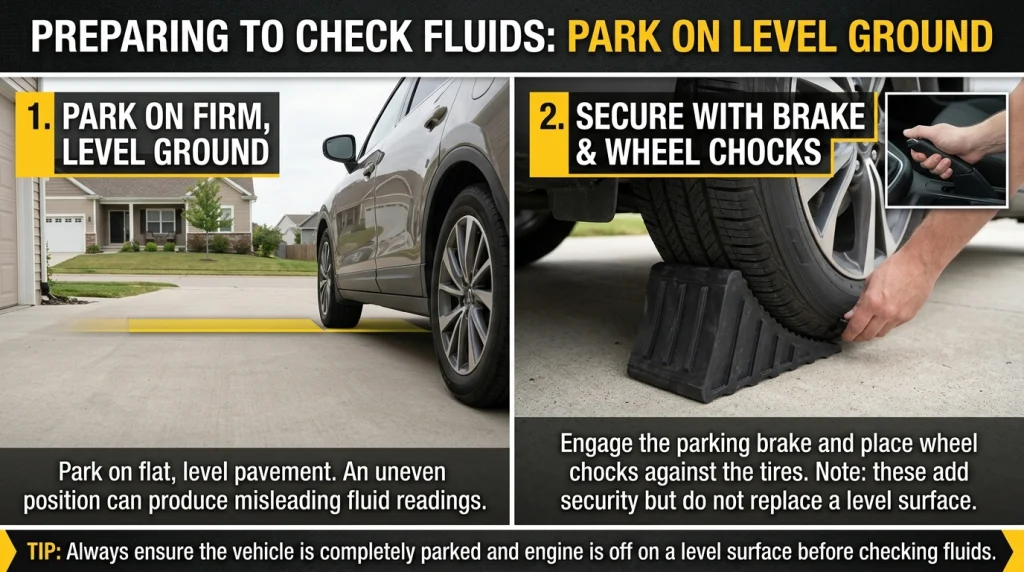
Park the car on firm, level ground. The parking brake and wheel chocks add security but do not replace a level surface. An uneven position can produce misleading fluid readings.
Follow the manual’s temperature instructions: some checks require a warm engine, while others require a completely cold vehicle to prevent burns or pressure injuries.
Gather gloves, shop towels, a flashlight, a funnel, and the owner’s manual
Wear nitrile gloves and, when appropriate, eye protection. Keep clean towels, a flashlight, and a funnel available to prevent spills while you check fluid or wipe a dipstick.
Use the owner’s manual to confirm the correct product, capacity, and procedure for your car.
Identify fluid reservoirs, dipsticks, warning labels, and fill points
With the engine off, identify the oil, coolant, brake fluid, and transmission fluid reservoir or dipstick. Check labels and the cap before adding anything.
Use the manual’s diagrams if you cannot identify a reservoir or fill point.
Prevent burns, chemical exposure, spills, and accidental vehicle movement
Work in a ventilated area, keep rags ready, and avoid contact with automotive chemicals. Never open a pressurized system while hot.
When to use wheel chocks, a cold engine, or professional assistance
Use chocks on an incline, wait for a cold engine when specified, and seek professional assistance if the inspection feels unsafe or requires specialized tools.
How to check car fluids with the correct inspection sequence
Learning how to check car fluids is easier with a consistent sequence. A repeatable routine helps you inspect each reservoir, level, and warning sign without overlooking an important system.
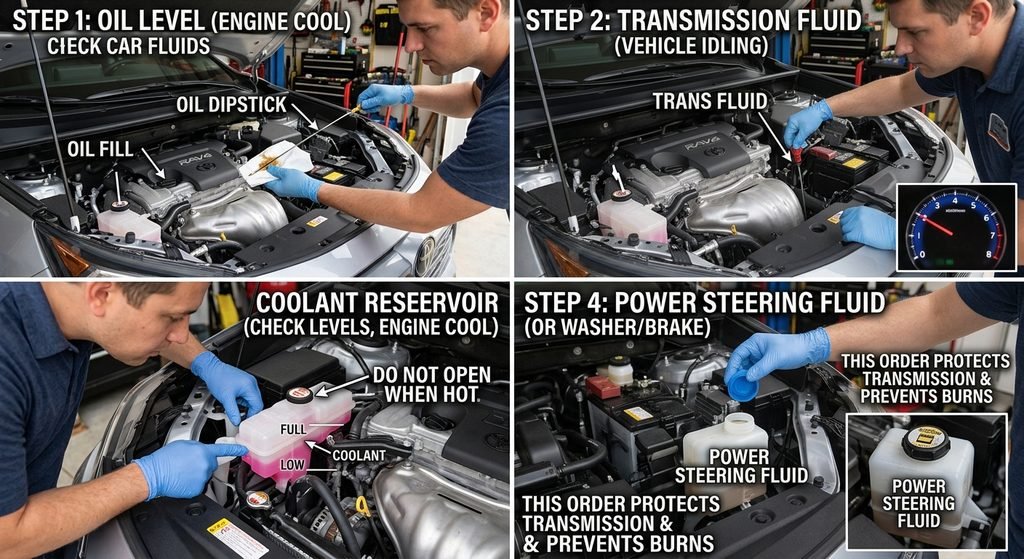
Follow a repeatable walk-around from the engine bay to the vehicle exterior
With the vehicle on level ground, follow the layout shown in your manual rather than assuming a clockwise route. Check the engine bay first, then inspect the windshield washer reservoir and exterior areas when applicable.
Compare fluid levels with the MIN, MAX, FULL, or ADD markings
Read each fluid level against its marked range. A dipstick or reservoir may show MIN and MAX, FULL, or ADD; use the manufacturer’s instructions before topping off.
Evaluate color, smell, texture, and visible contamination without touching fluids unnecessarily
Note changes in color, odor, texture, or debris without touching the fluid. Oil, coolant, and brake fluid vary by formulation and age, so appearance alone cannot confirm a fault.
Record low levels, unusual changes, and the date of each inspection
Record the date, mileage, fluid level, and visible changes. Rapid loss, warning lights, or repeated low readings require diagnosis rather than simply adding fluid.
| Fluid TypeIdeal LevelWarning SignAction Required | |||
| Engine Oil | Between Min/Max | Dark or Gritty | Change or Top-off |
| Coolant | At Cold Fill Line | Rust or Debris | Flush System |
| Brake Fluid | Near Max Line | Dark/Cloudy | Inspect Pads |
Why the owner’s manual overrides general fluid-checking advice
General guidance is only a starting point. Your owner’s manual specifies the correct temperature, engine state, product, and level for your car, protecting vehicle health and sensitive components.
Check Engine Oil Quickly and Read the Dipstick Correctly
Learning how to check car fluids starts with engine oil because the oil level helps reveal lubrication problems. Regular checks protect the engine, but follow your car manufacturer’s procedure.
Warm the engine, shut it off, and wait for oil to drain into the pan
Park on level ground and check your manual first: some engines require warm oil, while others require a cold check. After running the engine, switch it off and wait for the specified time so oil drains into the pan.
Remove, wipe, reinsert, and reread the dipstick for an accurate level
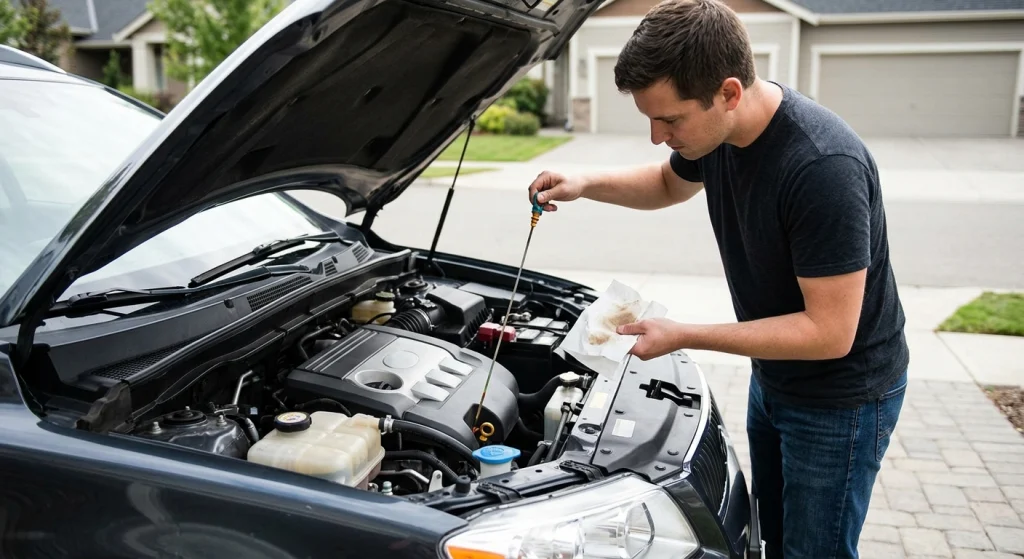
With the engine off, remove the dipstick, wipe it clean, reinsert it fully, and pull it out again. This is how to check oil and obtain a reliable oil level reading without residual oil causing confusion.
Interpret oil between the low and full marks without overfilling
Make sure the oil sits between “MIN” and “MAX” or reaches “FULL.” To check oil level accurately, reread the dipstick on level ground. Avoid overfilling, which can cause foaming and damage engine parts.
Recognize dark oil, milky oil, metallic particles, fuel smell, and sludge
Oil color alone does not determine condition. Dark oil may reflect age or miles, while milky oil, metallic particles, sludge, or a fuel smell can signal contamination or wear:
| Oil AppearancePotential MeaningRecommended Action | ||
| Dark/Black | Normal aging or high mileage | Schedule an oil change |
| Milky/Frothy | Coolant contamination | Seek professional repair |
| Metallic Flakes | Internal engine wear | Immediate inspection |
| Fuel Smell | Leaking injectors or rings | Consult a mechanic |
Add the manufacturer-specified oil in small amounts using a clean funnel
If the level is low, add the exact engine oil specification in small amounts through the oil reservoir or fill opening. Recheck the dipstick and stop within the marked range.
How to check for leaks around the filter, drain plug, valve cover, and oil pan
With the engine cool, inspect the filter, drain plug, valve cover, and oil pan for fresh oil or driveway spots. Persistent leaks require service.
When low oil pressure or repeated oil loss requires immediate service
If a low oil pressure warning appears, stop safely and turn off the engine. Repeated oil loss or visible leaks require immediate professional service.
Inspect Engine Coolant Safely and Accurately
Learning how to check car fluids includes checking coolant, which helps the engine maintain a safe operating temperature. Use the vehicle’s manual because each cooling system has specific requirements.
Check the coolant reservoir only when the engine is completely cool
Check the coolant level only when the engine is completely cool. Keep the radiator cap closed; a hot system can release pressurized fluid and cause serious burns. Inspect the reservoir from the outside unless the manual gives different instructions.
Read the level against the cold fill line on the expansion tank
Find the translucent reservoir or expansion tank and read its “MIN,” “MAX,” or “COLD FILL” marks with the engine cold. The coolant level should fall within the manufacturer’s specified range.
Distinguish normal coolant color from rust, oil contamination, and floating debris
Coolant color varies by formulation, so do not diagnose its condition by color alone. Murky fluid, an oily film, rust, or floating debris may indicate contamination and should be assessed by a qualified technician.
Use the correct coolant type and a premixed or properly diluted solution
Use the exact coolant specified for your car. Premixed coolant is ready to use; concentrate requires the manufacturer-approved dilution ratio. Do not mix incompatible formulas unless the manual permits it.
Inspect hoses, the radiator area, the reservoir, and the ground for leaks
Look for cracked or swollen hoses, residue around the reservoir, and puddles beneath the vehicle. A falling level or visible leak requires prompt service rather than repeated topping off.
Why opening a hot radiator cap can cause severe burns
A hot radiator cap can release boiling coolant and steam under pressure. Never open it until the engine is fully cool and the manual confirms that inspection is safe.
What an empty reservoir, overheating gauge, or sweet coolant odor may indicate
An empty reservoir, rising temperature gauge, or sweet odor may indicate a leak or another cooling-system fault. Pull over safely if the engine overheats and arrange professional service.
Verify Brake Fluid Level and Identify Brake-System Warnings
Learning how to check car fluids requires extra care around the brake system. Keep the reservoir and surrounding engine area clean because contaminated brake fluid can affect braking performance and vehicle health.
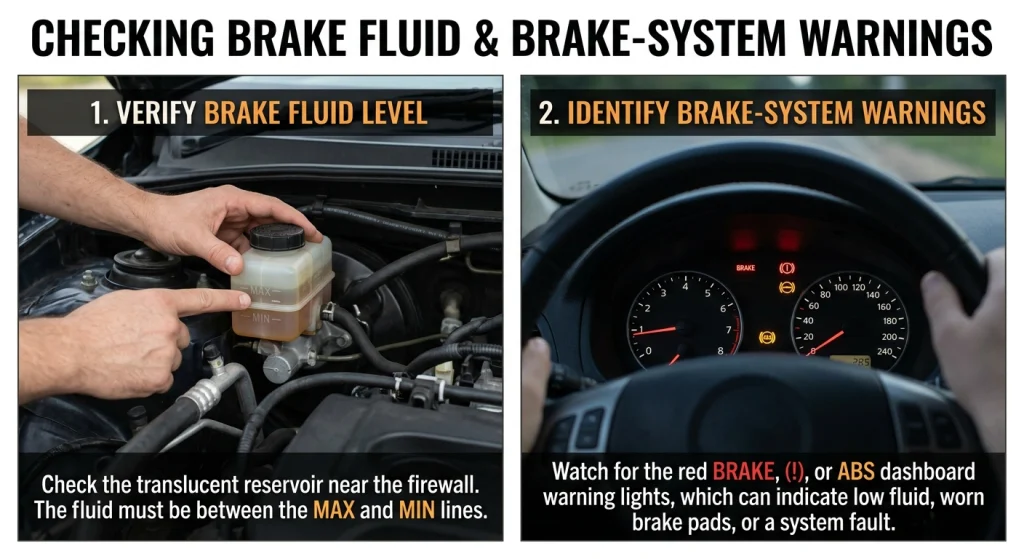
Locate the brake fluid reservoir near the master cylinder
The brake fluid reservoir is often near the master cylinder on the driver’s side, but its location varies by car. The translucent reservoir usually shows the fluid level without removing the cap.
Check the level without opening the reservoir unless the manual requires it
Read the level through the reservoir wall whenever possible. Open the cap only when the owner’s manual requires it, since moisture and dirt can enter the system.
Assess fluid color and look for moisture, sediment, or a damaged cap seal
Color varies, but dark or cloudy brake fluid, sediment, or a damaged seal warrants inspection.
Connect a low fluid level with possible pad wear or a hydraulic leak
A low fluid level can reflect brake-pad wear or a hydraulic leak. Do not automatically top it off; have the lines, calipers, and pads checked.
Never substitute power steering fluid, transmission fluid, or another product for brake fluid
Never add power steering fluid, transmission fluid, or another steering fluid. Use only the manufacturer-approved brake fluid specification; compatibility between DOT types depends on the vehicle.
“The safety of your vehicle relies on the integrity of your braking system; never ignore the warning signs of fluid degradation or loss.”
When a soft pedal, illuminated brake warning light, or visible leak makes driving unsafe
A soft brake pedal, warning light, or visible leak makes driving unsafe. Stop the car and arrange professional service immediately.
Measure Automatic Transmission Fluid According to Manufacturer Instructions
Learning how to check car fluids includes understanding that transmission fluid procedures vary by vehicle, mileage, and design. Always follow the manufacturer’s instructions rather than applying an engine-oil routine.
Determine whether the vehicle has a transmission dipstick or a sealed system
Check the manual to determine whether your vehicle has a transmission dipstick or a sealed system. Some transmissions have no accessible dipstick or owner-serviceable reservoir.
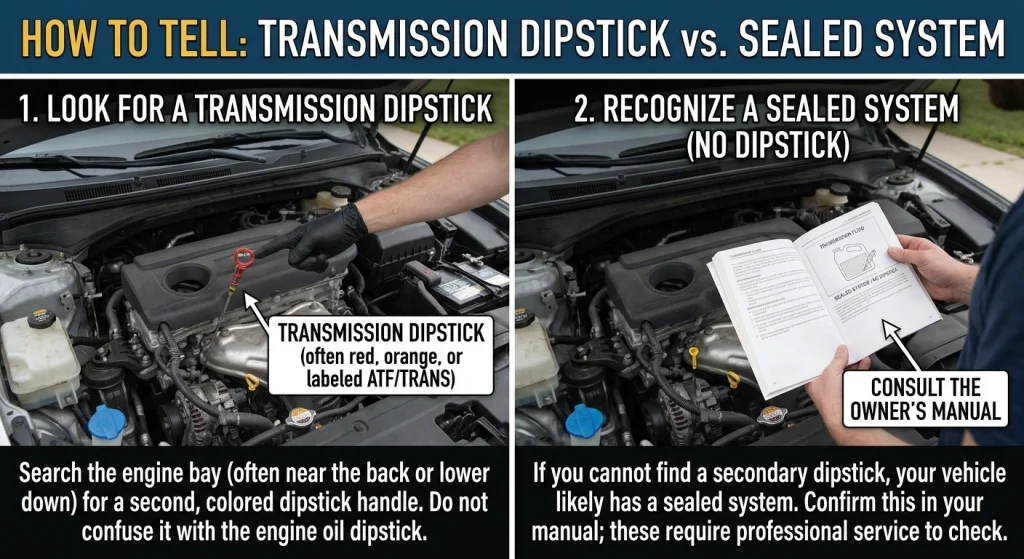
Follow the required temperature, engine-running, gear-selection, and parking procedure
For a dipstick-equipped transmission, the manual may specify a particular temperature, engine state, gear position, or gear-cycling sequence. Follow every step and keep the car secured in Park or as directed.
Read the dipstick consistently and avoid confusing transmission fluid with engine oil
Wipe the dipstick with a clean, lint-free cloth, reinsert it fully, and read the level as directed. Do not confuse transmission fluid with engine oil or steering fluid.
Evaluate fluid color, burnt odor, foam, and metal particles
Transmission fluid color varies by formulation and age. A burnt odor, foam, darkening, or metal debris warrants diagnosis but does not by itself prove that replacement is required.
Add only the exact fluid specification in small measured amounts
If the manual permits topping off, add only the specified transmission fluid in small amounts and recheck the level.
Why sealed transmissions should not be opened or topped off casually
Do not open a sealed transmission without the specified fill procedure, temperature tools, and equipment. Incorrect servicing can damage the system.
How delayed shifting, slipping, grinding, or fluid leaks change the inspection decision
Delayed shifting, slipping, grinding, or visible fluid leaks require professional service instead of a routine level check.
Check Washer Fluid, Power Steering Fluid, and Other Service Fluids
Learning how to check car fluids also means inspecting the fluid reservoir that supports visibility, steering, or emissions equipment. Check your vehicle’s manual before opening a cap or adding any product.
Fill windshield washer fluid without using water or engine coolant
Use the correct windshield washer fluid for your climate. Formulas differ for freezing temperatures and cleaning performance. Do not put engine coolant in the washer reservoir, and use water only when the product and manual permit it.
Inspect power steering fluid only when the vehicle is equipped with hydraulic steering
Check for a hydraulic power steering system and reservoir in the manual. If present, use only the specified power steering fluid; some vehicles require an approved transmission fluid instead.
Compare power steering fluid with the hot or cold markings specified by the manual
Read the steering fluid level at the temperature shown on the reservoir or in the manual. Add the approved fluid carefully because overfilling can affect steering performance.
Recognize that many newer vehicles use electric power steering with no reservoir
Electric power steering uses a motor rather than power steering fluid. If your car has no steering-fluid cap or reservoir, confirm the system type in the manual instead of adding a product.
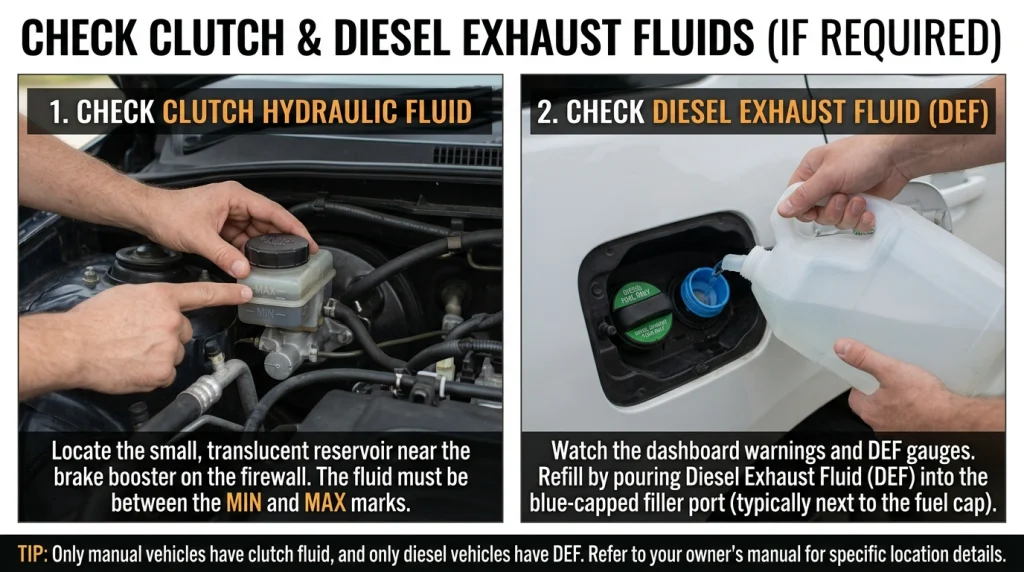
Check clutch hydraulic fluid and diesel exhaust fluid when the vehicle requires them
A manual vehicle may have a separate or shared clutch-fluid reservoir. Compatible diesel vehicles may require Diesel Exhaust Fluid (DEF); use only the product and service schedule specified for that vehicle.
Keep incompatible fluids out of shared-looking reservoirs
Check every cap label before adding washer fluid, steering fluid, or another fluid. Never confuse the washer with the coolant reservoir, and never mix products unless the manufacturer approves them.
Confirm Findings, Top Off Fluids, and Avoid Common Mistakes
Learning how to check car fluids includes confirming every reading and restoring the vehicle safely after inspection.
Recheck a questionable reading before adding fluid
Recheck a low reservoir or dipstick on level ground. Uneven parking, engine temperature, or an incorrect procedure can produce a false level.
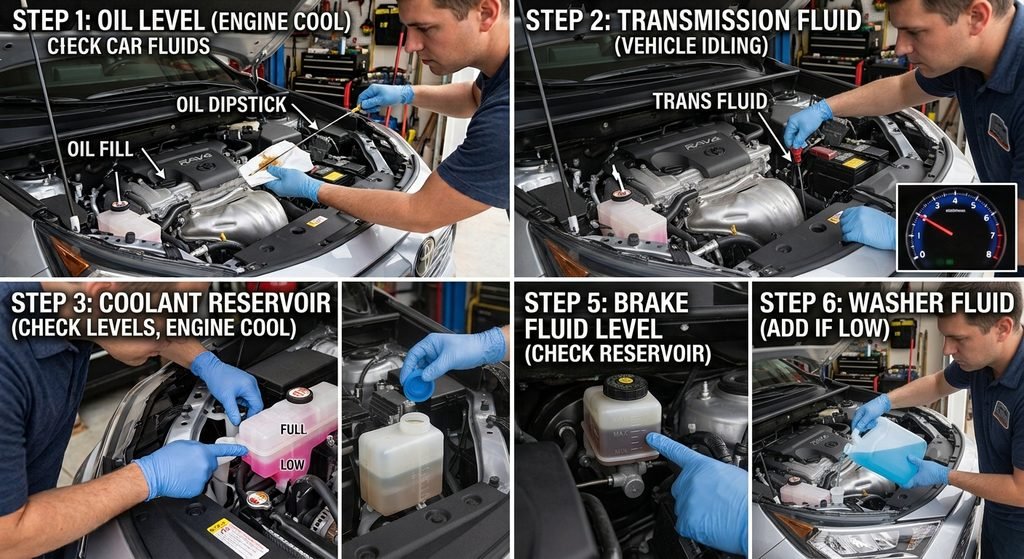
Top off gradually and stop below the maximum mark
Add the correct fluid in small amounts and keep it within the manufacturer’s marked range. Never overfill.
Clean caps and dipsticks before reinstalling them securely
Wipe caps and dipsticks with a clean towel, reinstall them securely, and close the hood to keep dirt out of the engine system.
Inspect for leaks after starting the engine and moving the vehicle
After all components are secure, start the car only when it is safe and check for fresh drips. Do not move the vehicle if you find a brake fluid leak or a major leak.
Avoid mixing incompatible specifications, using dirty containers, or relying on fluid color alone
Use clean containers and approved specifications. Do not rely on color alone to judge fluid condition.
How to dispose of used oil, coolant, brake fluid, and contaminated towels responsibly
Take used oil, coolant, and brake fluid to an authorized recycling or hazardous-waste facility. Never pour fluids onto the ground or down a drain.
When a fluid check should become a repair appointment instead of a do-it-yourself task
Persistent leaks, metallic particles, a burnt transmission odor, or warning lights require professional service.
Use a Maintenance Log to Turn Fluid Checks Into Preventive Care
Use how to check car fluids as part of a practical maintenance routine. A log can reveal gradual changes before they become major repairs.
Record fluid levels, appearance, mileage, and top-off amounts
Record the date, miles, fluid level, color, product added, and symptoms after each check.
“An ounce of prevention is worth a pound of cure, especially when it comes to the complex systems under your hood.”
Pair fluid inspections with oil changes, tire checks, and scheduled maintenance
Pair fluid checks with an oil change, tire inspection, and scheduled service to save time.
Use dashboard warning lights and vehicle symptoms as supporting evidence
Compare warning lights, unusual noises, or changing levels with your maintenance log before deciding whether a fluid is the cause.
Set a practical inspection schedule based on driving conditions and vehicle age
Older cars and vehicles used in severe conditions may need more frequent checks. Use the following table as a general guide:
| ConditionImpact on FluidsRecommended Action | ||
| Extreme Heat | Faster evaporation | Check monthly |
| Heavy Towing | Increased thermal stress | Check before/after trips |
| Dusty Roads | Contamination risk | Inspect filters and fluids |
How frequent short trips, towing, extreme temperatures, and dusty roads affect checks
Short trips can promote moisture in oil, while towing and temperature extremes increase transmission and cooling-system stress. Adjust the inspection schedule to your vehicle and driving conditions.
Conclusion
Regular checks of your car fluids can help you identify low levels, leaks, and warning signs before they become more serious. Learning how to check car fluids supports informed maintenance, but it does not replace professional diagnosis.
Inspect engine oil, coolant, brake fluid, and transmission fluid on level ground with clean tools. Follow the owner’s manual for the correct temperature, fluid specification, and level markings, and never open a hot radiator cap.
If your vehicle has a warning light, significant fluid loss, unusual odor, or unsafe brake symptoms, stop driving when appropriate and arrange professional service. Keep a maintenance log with dates and miles to track changes over time.
Take time to review your manual and schedule an inspection when needed. This routine helps protect your car’s health without promising a specific number of miles or a guaranteed result.
FAQ
What is the most critical safety rule for learning how to check car fluids at home?
Never open a hot radiator cap. Pressurized coolant can cause severe burns. Check the reservoir only when the engine is cool, park the vehicle on level ground, engage the parking brake, and follow the specified temperature procedure.
How can I distinguish normal engine oil from oil that may indicate a problem?
Oil color alone is not a diagnosis. Milky oil, metallic particles, sludge, or a fuel odor may indicate contamination or wear. Do not rely on topping off; arrange professional service for these signs.
What is the difference between checking a dipstick-equipped transmission and a sealed system?
A transmission dipstick system requires the manufacturer’s instructions for temperature, engine state, gear selection, and level reading. Do not open a sealed transmission without the specified tools and procedure. Slipping, grinding, or delayed shifting requires service.
Why is my brake fluid low, and should I fill it back up?
A low brake fluid level may result from pad wear or a hydraulic leak. Do not automatically add fluid; have the system inspected. A soft brake pedal, warning light, or visible leak makes driving unsafe.
Can I use tap water as a substitute for windshield washer fluid or engine coolant?
Use the manufacturer-approved coolant and washer fluid for routine maintenance. Coolant requires the specified formula and dilution, while windshield washer fluid should suit the climate. Do not put coolant in the washer reservoir or rely on tap water as a routine substitute.
Does every car have a power steering fluid reservoir to check?
No. A vehicle with hydraulic power steering may have a power steering fluid reservoir, while electric power steering uses a motor and no steering fluid. Check the manual before looking for or adding fluid.
How does a maintenance log help with long-term vehicle health?
Record the date, miles, fluid level, product added, and symptoms. This history can reveal gradual leaks or changing fluid use, especially when driving involves towing, dust, or extreme temperature.
What tools should I have for a basic DIY fluid inspection?
Keep nitrile gloves, clean towels, a flashlight, and a clean funnel available. The owner’s manual is essential because it identifies the correct fluid, capacity, temperature, and procedures for your car.
One Comment